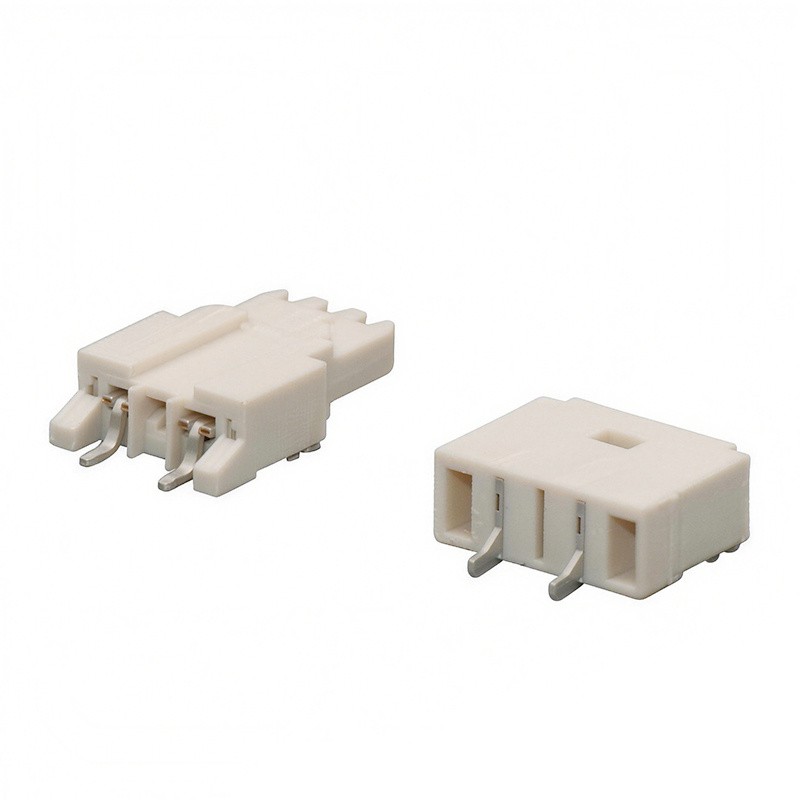
L2502: 2.5 mm Pitch LED Connector
Product Features
L2502 2.5mm Pitch LED Connector Technical Solution
The L2502 series of connectors has been specifically optimized to address the space constraints and long-term operational stability requirements of compact LED lighting systems, providing an industrial-grade interconnect solution for the mass production of micro-devices.

Design Advantages
1. Compact, Standardized Design: With a 2.5mm center-to-center pitch, it enables efficient interconnection within limited PCB space, supporting the miniaturization and lightweight design of LED devices while maintaining compatibility across the series of interfaces.
2. High-Temperature-Resistant Insulation System: Utilizes engineering-grade insulation materials to maintain stable insulation performance even in the high-temperature operating environments of LED fixtures, preventing the risk of leakage and short circuits, and adapting to the enclosed operating environments of micro-fixtures.
3. Low-Loss Contact Design: An optimized contact terminal structure ensures low contact resistance, reduces power transmission losses, and improves the overall energy efficiency of micro-lighting systems.
4. Process Compatibility: The surface-mount pin structure supports SMT placement and reflow soldering processes, enabling efficient integration with LED luminaire PCBs and meeting the demands of mass production.
Technical Specifications
|
Pitch |
2.5 mm |
|
Rated Current |
1.0A AC/DC |
|
Rated Voltage |
250V AC/DC |
|
Insulation Resistance |
≥800 MΩ |
|
Contact Resistance |
≤20 mΩ |
|
Withstand Voltage |
800 V AC/minute |
|
Temperature Range |
-25°C to +105°C |

Production Process
Jiankun's production process adheres to professional quality control standards for electronics manufacturing and is divided into three core stages: front-end manufacturing, mid-end manufacturing and quality control, and back-end warehousing and delivery, as detailed below:
Front-End Process: Component Forming
1. Terminal Stamping and Forming
Using high-purity copper strip as raw material, high-speed precision stamping equipment is employed to cold-form terminal blanks. The structural precision and mechanical strength of the terminals are strictly controlled, laying the foundation for subsequent electrical connection performance.
2. Terminal Electroplating
Qualified external suppliers perform surface treatments such as gold plating, tin plating, and nickel plating to enhance the terminals' conductivity, oxidation resistance, and insertion/removal durability, while meeting industry environmental and reliability requirements such as RoHS and REACH.
3. Injection Molding of Plastic Housings
Engineering plastic pellets (such as PA66 and LCP) are melted at high temperatures using precision injection molding machines and injected into molds to form the connector housing, ensuring dimensional stability, insulation performance, and temperature resistance.
Mid-Process Manufacturing and Quality Control
1. Automated Assembly
High-speed pin insertion equipment is used to precisely insert and lock the electroplated terminals into the injection-molded housing, forming the connector's electrical connection structure. A vision positioning system ensures assembly accuracy throughout the entire process.
2. CCD Visual Inspection
A high-resolution CCD vision inspection system is used to automatically inspect for外观 defects (such as terminal deformation or flash on the plastic housing) and dimensional accuracy (such as terminal alignment deviation), with a detection accuracy of up to ±0.01 mm.
3. Tape-and-Reel Packaging
Qualified products are packaged on carrier tapes and cover tapes to meet the SMT automated placement process requirements of downstream customers, while also preventing damage during transportation and storage.
4. Final 100% Inspection
Through a combined "manual visual inspection + electrical performance testing" process, we verify core electrical metrics of the connectors-including electrical continuity, withstand voltage, and insulation resistance-to ensure products comply with industry quality system requirements such as IATF 16949.
Back-End Warehousing and Delivery
1. Batch-Based Inventory Management
Qualified products are scanned and received into inventory via the WMS (Warehouse Management System), enabling production batch traceability, dynamic inventory control, and First-In, First-Out (FIFO) management.
2. Order Fulfillment and Shipping
Picking and preparation are completed according to customer order requirements, and shipments are arranged through the logistics system. Batch traceability reports and Certificate of Conformity (COC) are provided throughout the process to ensure timely delivery and traceable quality.

Production Site
Jiankun Connectors' core production base is supported by a fully autonomous end-to-end production system, covering the entire manufacturing process from raw materials to finished products. Through specialized workshop layouts and precise division of labor across production stages, the facility has established a highly efficient and controllable closed-loop manufacturing system, providing a solid foundation for product consistency, reliability, and on-time order delivery.
1. Injection Molding Workshop
Equipped with high-precision electric injection molding machines and temperature-controlled mold systems, this facility uses high-performance engineering plastics such as PA and PBT to mold product housings and insulating components. Through strict process parameter control and a comprehensive mold maintenance system, we ensure consistent part dimensions, smooth surfaces, and excellent mechanical strength and weather resistance, thereby guaranteeing the structural reliability of our products from the very beginning.
2. Stamping Shop
Equipped with multi-station precision stamping presses and progressive dies, this workshop uses highly conductive electrolytic copper strip as raw material to continuously perform processes such as stamping, bending, and cutting of terminals. Pressure and displacement are monitored in real time during the stamping process to ensure terminal contour accuracy, spring plate consistency, and cross-sectional quality, providing dimensionally precise, burr-free, and reliable workpieces for subsequent electroplating.
3. Assembly Shops I and II
These workshops feature fully automated assembly lines that integrate vibratory feeding, precision crimping, and in-line inspection functions to achieve precise assembly of terminals and plastic housings. The lines are equipped with force sensors and CCD vision systems that monitor insertion force and positional deviations in real time during the crimping process, while simultaneously performing initial inspections of appearance and assembly dimensions, effectively preventing defective products from entering subsequent stages.
Our fully autonomous production process not only covers the entire "injection molding–stamping–electroplating–assembly–inspection" workflow but also enables real-time traceability of process parameters, quality data, and production status through the MES system. This system ensures production capacity and delivery flexibility while maintaining continuous control over product quality throughout the entire supply chain, consistently meeting customer demands for highly reliable connection solutions.

Packaging and Transportation
JKUN has established a standardized product packaging and logistics management system to ensure product integrity, traceability, and delivery efficiency during warehousing and transportation.
1. Standardized Packaging and Warehousing
Products are packaged using protective packaging that complies with industry standards: secured internally with anti-static carrier tape or blister trays, and externally enclosed in five-layer corrugated cardboard boxes that meet strength requirements. Each box is clearly labeled with the product model, quantity, and production batch number. Once boxed, they are stacked in a uniform pattern on wooden pallets and secured with stretch film to facilitate mechanized forklift operations and bulk transportation.
Products should be kept in their original packaging and stored in a clean, dry, and well-ventilated professional warehouse environment. Recommended storage conditions are: temperature 15°C–25°C, relative humidity below 60%. Avoid direct sunlight, extreme temperature fluctuations, or storage alongside corrosive substances. The number of stacking layers must comply with the packaging label requirements to prevent deformation or damage caused by prolonged pressure.
2. Diverse Shipping Options
We offer flexible and customizable transportation services, including:
- Domestic Full Truckload (FTL)/Less Than Truckload (LTL) Logistics: Suitable for large-volume orders, with door-to-door coverage;
- International Express: Supports global networks such as UPS, DHL, FedEx, and TNT to meet the needs of samples and urgent orders;
- Air and Ocean Freight: We provide international logistics solutions, including door-to-port and door-to-door options, suitable for export orders with varying time-sensitive and cost requirements.
Transportation solutions are comprehensively optimized based on the customer's location, delivery timelines, cost budget, and shipment volume, and we provide end-to-end logistics tracking information throughout the process.
3. Transportation Safety and Operational Guidelines
During transportation, packaging should be protected from punctures by sharp objects, heavy pressure, or violent impacts to prevent product contamination or mechanical damage caused by damaged outer packaging. Under proper handling and storage conditions, this product poses no undue health hazards to personnel. It is recommended to follow general industrial safety standards during loading, unloading, and unpacking, to properly dispose of packaging materials, and to maintain a clean and orderly work environment.
We are committed to ensuring that products are delivered to customers on time and in perfect condition through systematic packaging, warehousing, and transportation management, providing end-to-end support for the reliability and stability of the supply chain.

Quality Assurance and Quality Control
Jiankun's quality management system is built upon a framework of internationally recognized certification standards. Through multi-dimensional system certifications and end-to-end process control, we ensure that our products are of consistent quality, compliant with regulations, and meet global market requirements:
Quality Assurance System Backed by Authoritative Certifications
We have established a compliance system covering quality, environmental, and industry-specific areas. Our core certifications and their corresponding scopes of coverage include:
1. IATF 16949 Automotive Quality Management System Certification
Designed to meet the quality control requirements for automotive electronic products (such as in-vehicle connectors and body control system components), this system covers the entire product lifecycle-from design and production to delivery. It incorporates tools such as FMEA (Failure Mode and Effects Analysis) and SPC (Statistical Process Control) to ensure products meet the automotive industry's stringent standards for high reliability and stability.
2. ISO 9001 Quality Management System Certification
Establishes standardized quality control processes for all product categories, from order review and raw material procurement to finished product delivery, enabling quantitative management of quality objectives and continuous improvement at every stage to ensure product consistency and precise alignment with customer requirements.
3. ISO 14001 Environmental Management System Certification
We incorporate environmentally friendly principles into our production and quality control processes, using low-pollution, recyclable materials and processes to balance product quality with environmental compliance.
4. UL/CUL Safety Certification
Products have passed U.S. and Canadian safety standard testing, with metrics such as electrical performance and material flame retardancy meeting North American market safety regulations, ensuring electrical safety in end-user applications.
5. CE Compliance Certification
The product complies with EU regulations regarding electromagnetic compatibility (EMC), safety, and other requirements, and is eligible for legal entry into the EU and global markets that recognize CE standards.
End-to-End Quality Control Measures
Building on the aforementioned certification systems, we have established an end-to-end quality control mechanism covering "incoming materials – production – finished products":
1. Incoming Quality Control (IQC)
We conduct 100% inspection of raw materials (such as copper strips, engineering plastics, and plating materials) upon arrival at the factory. Based on the IATF 16949 standard, we have established raw material acceptance specifications. Through tests such as chemical composition analysis, dimensional inspection, and weather resistance testing, we ensure that raw materials meet product design specifications and prevent non-conforming materials from entering the production process.
2. In-Process Quality Control (IPQC)
Dedicated process inspectors are assigned to each production stage (stamping, injection molding, electroplating, and assembly). We use SPC tools to monitor key process parameters (such as stamping dimensional tolerances and injection molding temperatures). Additionally, through in-line inspections of structural features-such as double-lock plate secondary locking and external hook locking mechanisms-we ensure the production process complies with ISO 9001 standards and promptly intercept nonconforming products during production.
3. Final Product Inspection (FQC)
A comprehensive inspection is conducted on all finished products before shipment, covering electrical performance (contact resistance, rated current), mechanical performance (holding force, insertion/removal cycle life), and environmental adaptability (vibration, temperature and humidity cycling). Safety and compliance metrics corresponding to UL/CUL/CE standards are also verified. Products are only accepted into inventory after passing these inspections, ensuring 100% conformance of delivered products.
Quality Traceability and Continuous Improvement
We have established a unique product identification and traceability system that allows us to trace the source of raw materials, production processes, and test data via batch numbers. Furthermore, in accordance with the continuous improvement requirements of ISO 9001, we regularly collect customer feedback and production process data to optimize quality control processes and ensure the dynamic improvement of product quality.

Company Profile
Wenzhou JKUN Connectors Co., Ltd. (JKUN), established in 2013, is a national-level high-tech enterprise specializing in the R&D, design, manufacturing, and sales of connectors.Rooted in the field of precision electronic interconnects, the company has developed a product portfolio centered on automotive connectors (including solutions for vehicle lighting, in-vehicle electronics, and electronic control systems), new energy connectors (covering battery management, charging interfaces, and high-voltage power distribution systems), industrial and consumer electronics connectors, and specialized LED lighting connectors, providing customers with highly reliable, customized interconnection solutions.
The company strictly adheres to international quality management systems and has successively obtained ISO 9001 Quality Management System, ISO 14001 Environmental Management System, ISO 45001 Occupational Health and Safety Management System, and the authoritative IATF 16949 certification for the automotive industry, as well as numerous international product safety certifications such as UL, CUL, and CE.In addition, the company's testing laboratory has been accredited by the China National Accreditation Service for Conformity Assessment (CNAS), giving it the capability to conduct independent testing and verification in line with international standards.
Looking ahead, Jiankun will continue to focus on strategic industries such as artificial intelligence, 5G communications, and new energy, while deepening its technological footprint and industry applications. Through a systematic market strategy, a comprehensive technical support network, and a professional, dynamic R&D and operations team, the company is committed to rapidly achieving independent technological innovation and sustainable development in rapidly growing market segments, providing customers with more competitive connectivity technology products and services.

Hot Tags: micro led 2.5mm pitch connector, China micro led 2.5mm pitch connector manufacturers, suppliers, factory