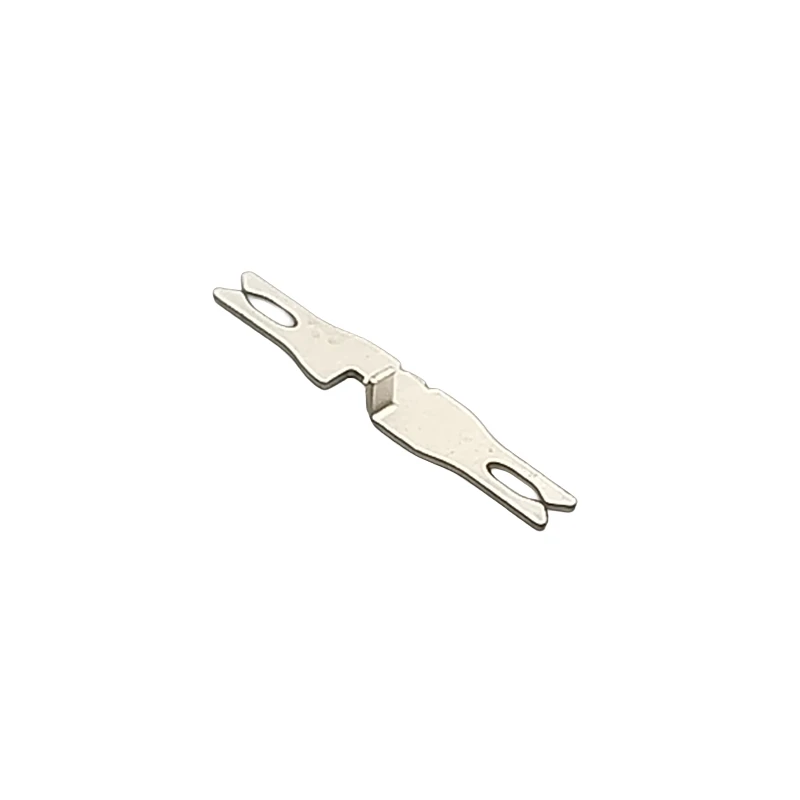


L109 Flat Blade LED Piercing Terminal
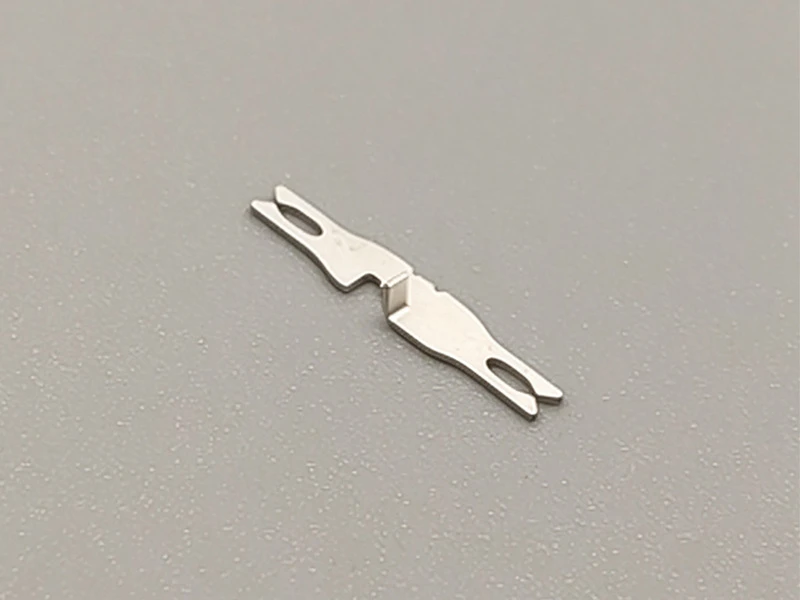
L109 is a flat blade piercing terminal for LED wiring, formed as a thin plate with an IDC slot so it can sit under a strip or alongside a board where height is the binding constraint. The plate lies flat, the wire is pressed into the slot from above, and the blades displace the insulation and contact the conductor, so no stripping or soldering is needed. Being flat rather than a cube, it can be placed in a shallow gap and can also be soldered to a pad on the board face, which makes it useful at a strip end where a raised connector would foul the diffuser. The terminal is a single stamped part with no internal joint, and the joint at the slot can be seen after insertion. Because the plate is thin, the joint sits below the height of the diffuser and the wire can be dressed flat along the strip instead of standing away from it.
We stamp the L109 plate and hold flatness and the location feature to the press tool, so the part is held by tooling rather than by an operator's fingers when it is pressed. The plate sits below diffuser height, and the wire can be dressed flat along the strip after termination.
Specifications
|
Parameter |
Specification |
|
Model |
L109 |
|
Product type |
Flat blade piercing terminal |
|
Structure |
One-piece stamped thin plate |
|
Termination |
Piercing, no stripping, no soldering |
|
Mounting |
SMT placement or manual assembly |
|
Applicable circuit |
LED low-voltage lighting circuit |
|
Plating |
Gold, tin or nickel, selectable |
|
Compliance |
RoHS, REACH |
Applications
LED Strips Under a Diffuser
A diffuser sits close to the strip. A flat terminal adds almost no height, so the joint can be made without the diffuser fouling the connection or the wire.
Shallow Housings and Profile Channels
Where the internal gap is a millimetre or less, a plate fits where a cube cannot. The wire is pressed from above into the slot and the joint stays within the gap.
Strip Ends Joined Directly on a Board Pad
The flat body can be soldered to a pad and then take the wire, which combines a board joint and a wire joint in one small part without a connector housing.
Customization
- Plate thickness and slot width are set together, since the stiffness that keeps the body flat and the gap it has to fit both come from the same dimension.
- A locating hole or tab can be added so the part is held during pressing.
- Plating can be quoted for the wire material and the environment behind the diffuser.
- Samples are pressed in a fixture that holds the part the customer's tool would and pull-tested with the specified wire; development takes 7 to 30 days.
- Minimum order quantity is one set, negotiable by item, with different sizes of parts mixable in one order.
Packaging & Transportation
Supplied on tape or in trays so that the flat body is not bent in transit; desiccant is included in the barrier bag.
100% inspection before packing covers plate flatness and slot position; joint quality is sampled per lot by pressing and pulling the specified wire.
Reels or trays are cartoned, palletised and strapped, with wooden cases for sea freight. EXW, FOB and DDP can be quoted.

Frequently Asked Questions
Q1. How much height does the terminal add?
+
-
The part is a formed plate, so the height above the board is essentially the plate thickness plus the wire. The exact figure depends on the plate thickness chosen for your gap, which is confirmed on the drawing.
Q2. Does the plate bend when the wire is pressed in?
+
-
Plate thickness is set so the press load goes into the blades rather than bending the body, and a locating hole or tab can be added to hold the part during pressing.
Q3. Can it be soldered to a pad as well as used loose?
+
-
Yes. The flat base can be soldered to a board pad, which lets one small part make both the board joint and the wire joint.
Hot Tags: l109 flat blade led piercing terminal, China l109 flat blade led piercing terminal manufacturers, suppliers, factory